The data center without fans.
Loring Data Center is built on LiquidCool Solutions chassis immersion. No chillers, no air handlers, no water consumed. Hydro-backed power on its own grid, fiber routes to Boston and Halifax, and a campus engineered to run year-round at 47 degrees north.
Air is an insulator. We stopped fighting it.
Every conventional data center spends a large share of its power blowing heat away with fans, then chilling the air it just heated. At Loring, every server sits in a sealed chassis of dielectric liquid that carries 100 percent of the heat out of the rack. The hottest chips get directed flow. Everything else is cooled by the bulk liquid. There is nothing to blow.
A hall designed for this hardware needs no chillers, air handlers or water treatment. That cuts the capital cost of the facility by about 60 percent and maintenance by about 90 percent, and the same compute that fills 115 air-cooled racks fits in 24.
A conventional air-cooled hall
- Chillers, air handlers and water treatment to build and maintain, with about 40 percent of facility power going to the chillers
- Fans in every server, adding their own heat to the load
- Rack density tops out near 15 kW
- Dust, humidity and oxidation working on every board
- Millions of gallons of water lost to evaporation, and heat vented to the sky as waste
- Noise at levels that call for hearing protection
Loring, on LiquidCool chassis immersion
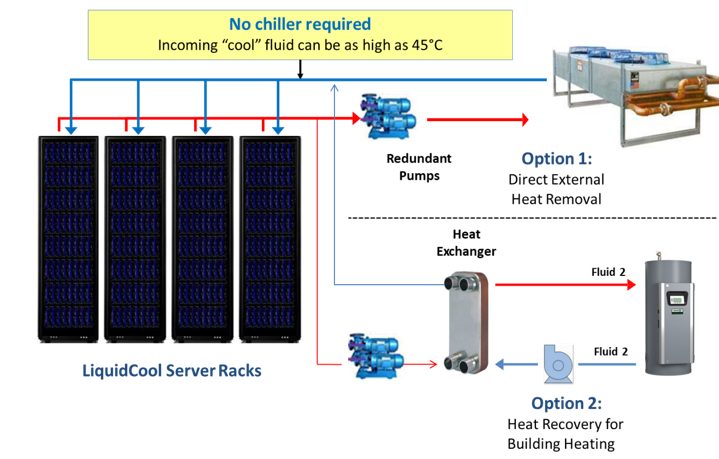
- No chillers, no air handlers, no CRAC units. Pumps and dry coolers only.
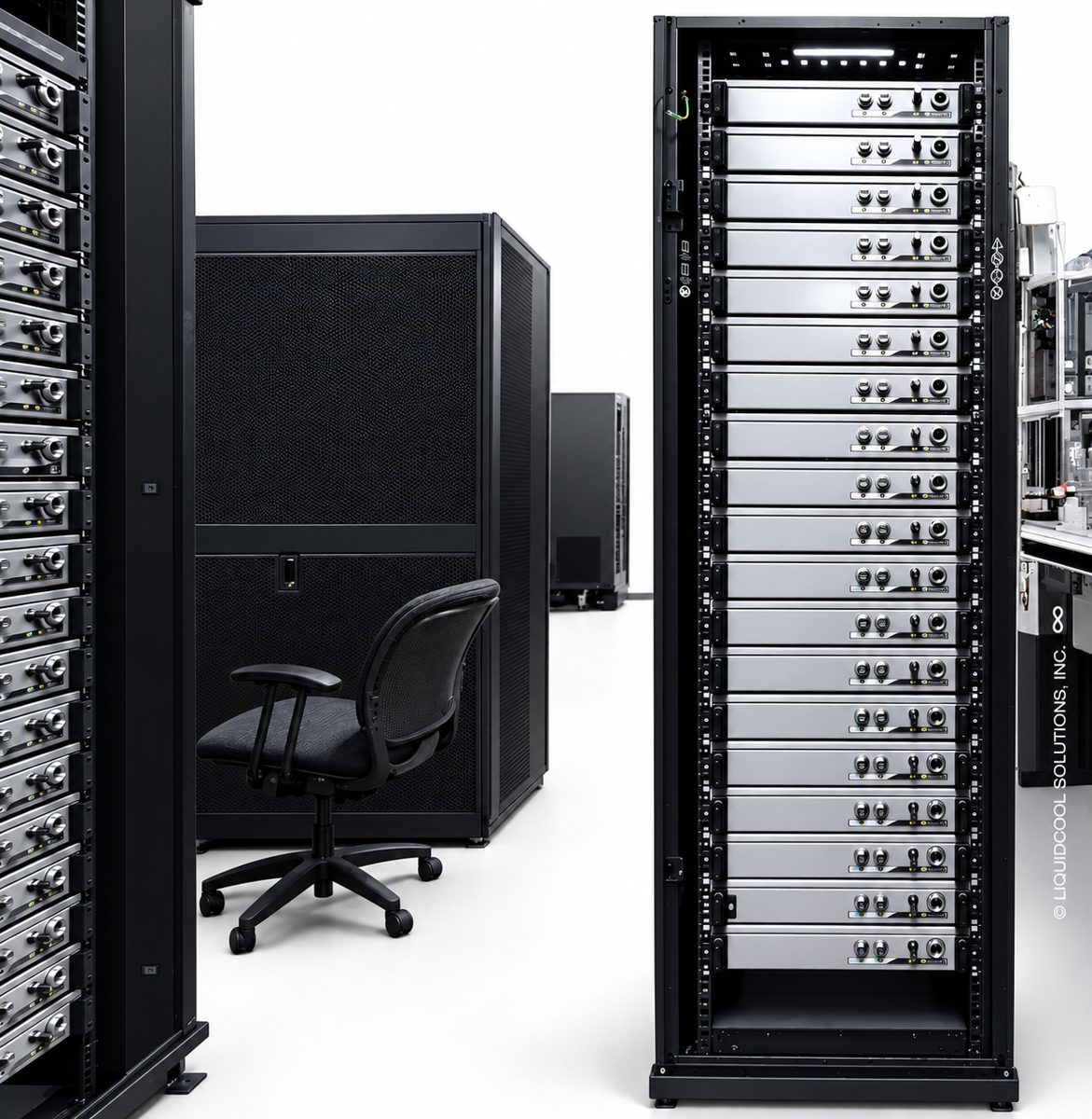
- 24 racks do the work of 115 air-cooled racks
- No fans in the chassis. Up to 40 percent less on-site energy and CO2.
- Components sealed from room air, so hardware lasts longer
- Incoming fluid can be as warm as 45 C, so no chiller is needed anywhere
- Up to 95 percent of waste heat recovered as liquid at up to 60 C, ready to be reused
- Cooling PUE below 1.03 at the rack
- No fans, no roar. Quiet enough to hold a conversation in the hall.
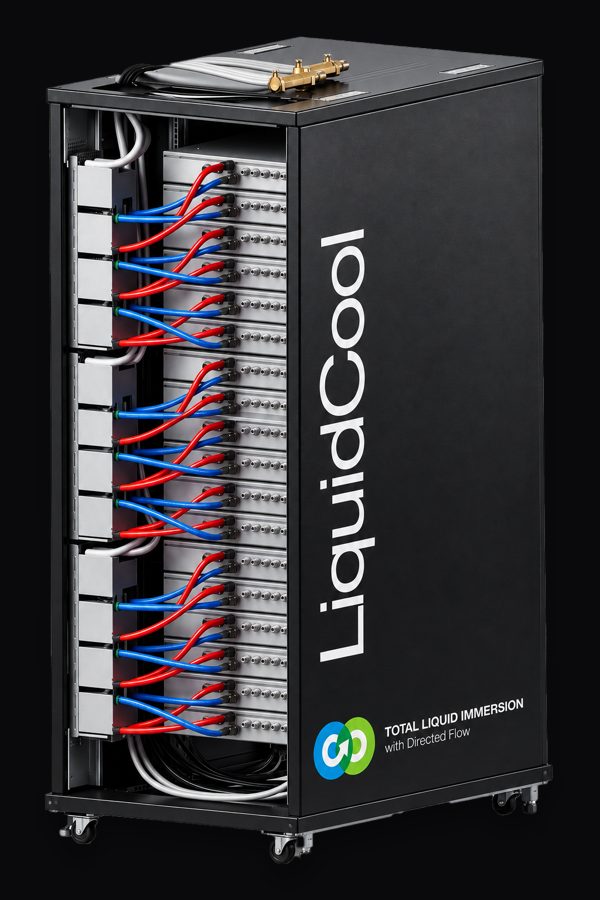
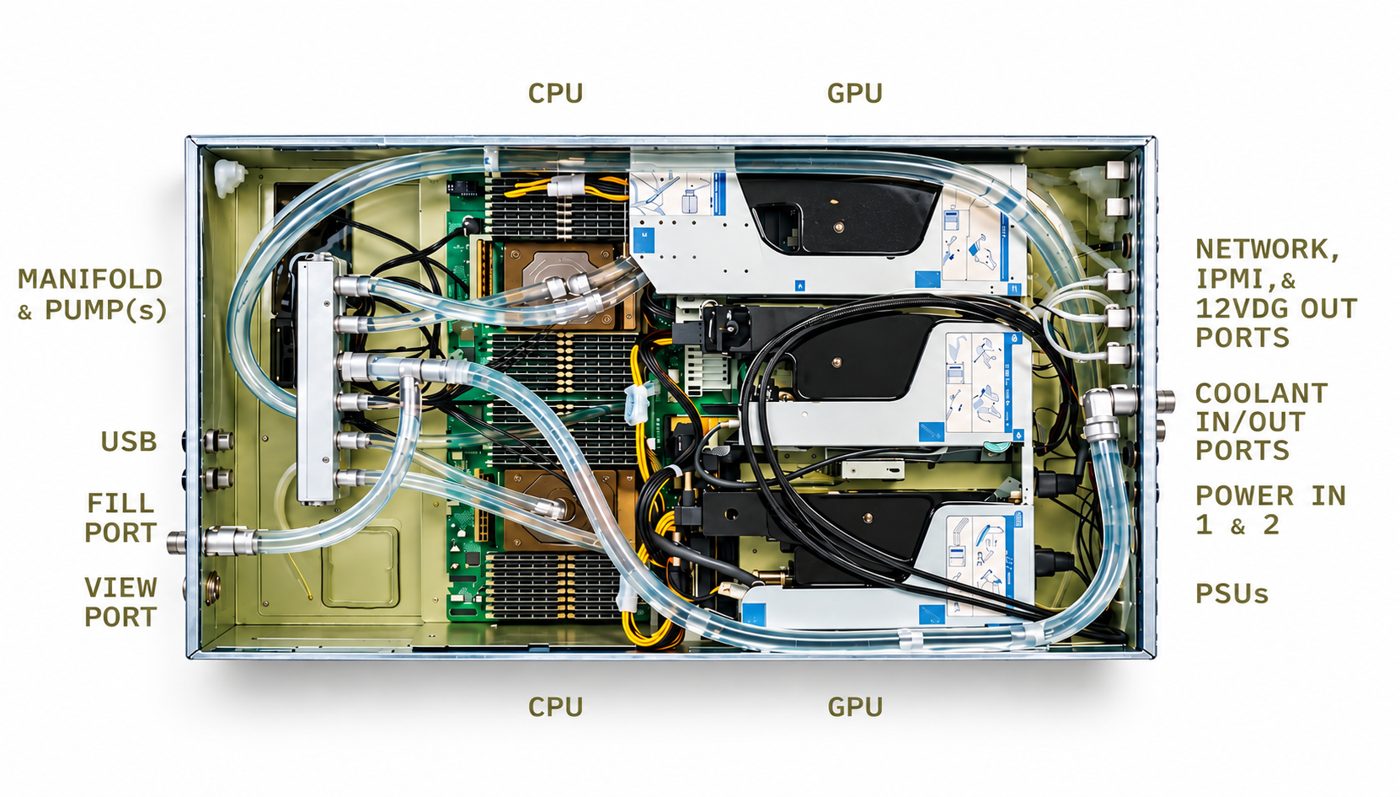
Inside a LiquidCool server
- 1. Coolest fluid to the hottest partsDirected flow sends fresh coolant to the processors first.
- 2. Everything else is immersedThe fluid then bathes the rest of the electronics and collects the remaining heat.
- 3. Sealed, liquid-tight chassisHeat leaves in the fluid to be cooled outside and returned. Nothing touches room air.
Standard racks
LiquidCool chassis fit standard 19 inch racks. You access servers the same way you do now. A service swap takes minutes and is dripless.
Off-the-shelf parts
Intel and AMD platforms, standard memory, SSD and helium drives. The chassis, fluid and connectors are reused when you refresh the electronics.
Fluid that lasts
The dielectric liquid is inexpensive, has a global warming potential of zero, and never needs replacing. After 36 months at full load, boards show no oxidation or corrosion.
LiquidCool Solutions is the company whose chassis immersion runs every rack at Loring. It is the only firm combining total liquid immersion with directed flow to the hottest components in a standard 19 inch vertical rack, with 72 granted patents and 5 pending, and its performance has been independently verified: Berkeley Lab measured it 30 times more efficient than air cooling in a tropical climate, NREL called it the gold standard for data centers in connected buildings, Intel found zero deleterious effect on processors, and the Solar Impulse Foundation certified it as an efficient, profitable clean-tech solution. It is built from off-the-shelf components from Intel, AMD, NVIDIA, Samsung and Supermicro, among others. Loring is built as the proving ground for the technology: a working data center designed from the first drawing around fanless servers.
Read about the company, the engineering and the test data at liquidcoolsolutions.com.
Built for the Cold War. Ready for dense compute.
Loring Air Force Base was a Strategic Air Command installation, the northeastern anchor of the bomber fleet through the Cold War. The campus was engineered to operate every day of a northern Maine winter: hardened buildings, twin 2.5 mile runways, and utility infrastructure sized for a military city.
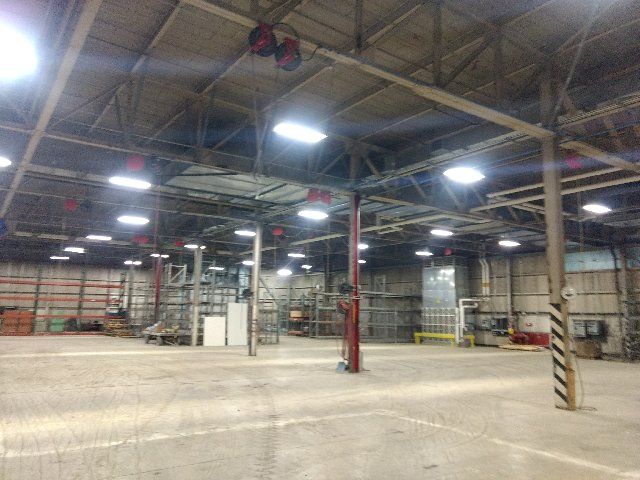
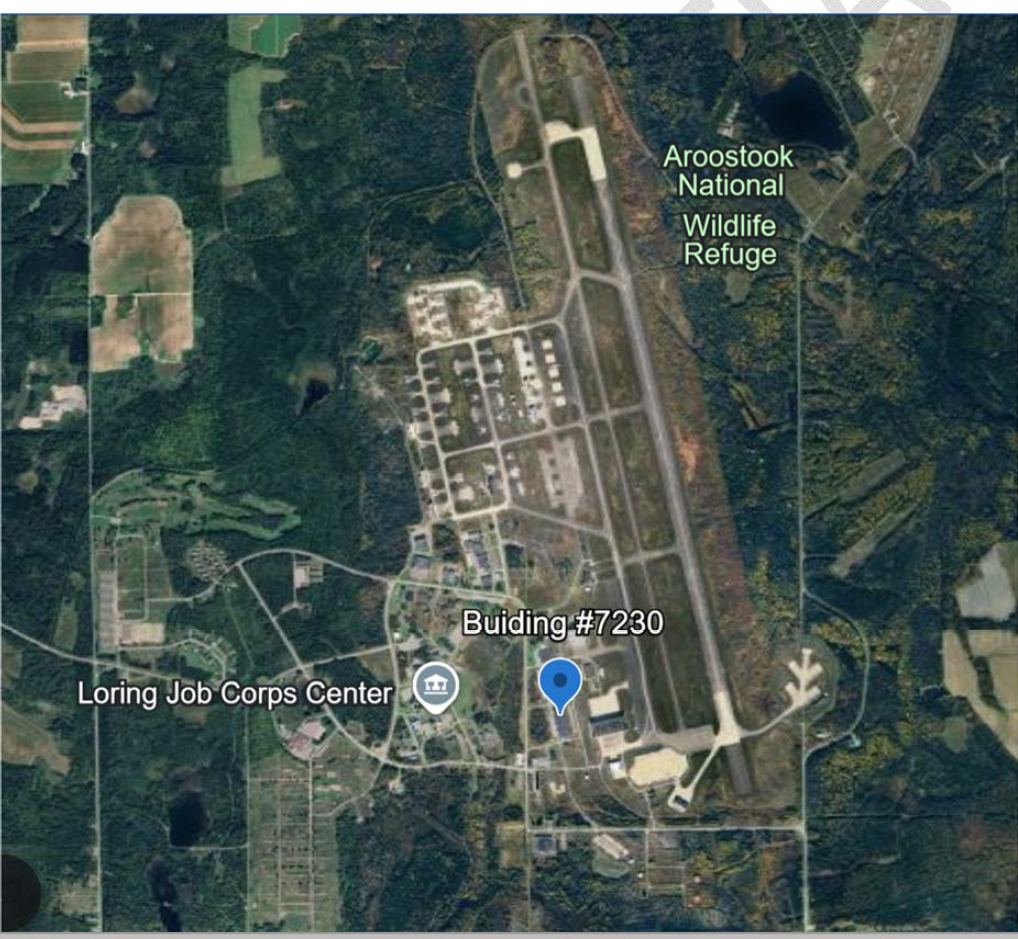
Building 7230 sits at the south end of the flight line at 89 Kansas Road, Limestone. It carries 115,000 square feet of enclosed space on a 50-year lease, with up to 50,000 square feet of office space available to tenants who want their people next to their hardware.
Power arrives from a regional grid supplied largely by New Brunswick hydroelectric generation. Two megawatts serve the building today, with a further 24 megawatts under a signed will-serve agreement with Versant Power, brought on in phases. Fiber reaches the site over Maine's Three Ring Binder middle-mile network, with routes south to Boston and east to Moncton and Halifax, and access to the transatlantic backbone. The site is about 25 minutes from Presque Isle International Airport.
The site lies in a rural federal Opportunity Zone and about 30 minutes from the New Brunswick border.
Pick one. You have a data center.
Loring does not build air-cooled halls. Every deployment runs on liquid. Tell us your workload and your server spec, and it lands in one of three options.
One monthly rate
Priced per kilowatt of committed power. Power and connectivity bundled into the rate, or metered, your choice.
Three to five year terms
Room to try it and room to grow, without a life sentence.
Office space on site
Up to 50,000 square feet alongside the hall for teams that want to be close to their equipment.
Partners welcome
Managed service providers, IT consultancies and brokers earn a referral fee for the life of the customer. Ask for the partner program.
Routine compute, done right.
Loring is for the workloads most businesses actually run: dense CPU compute, storage, backup and disaster recovery, hosted private cloud. Bring us your spec and we will tell you what fits.
- Maine and New England manufacturersMove the servers out of the shop floor closet and into a hall built for them, in state.
- Disaster recovery and second site for Boston and Portland300 miles of real geographic diversity on a separate grid from southern New England, same time zone, drivable, on cheaper power. Built for backup, archive, DR and steady-state compute, not as a cloud on-ramp.
- Defense suppliers and federal contractorsUS-soil hosting for controlled data at a former SAC base. Power and connectivity are the whole requirement.
- Managed service providers and integratorsA place to host client infrastructure at a cost that lets you keep your margin.
- Research, HPC and hospital systemsExpand the cluster without building the room.
- Canadian companiesA United States footprint 30 minutes from the border, with power available on an existing will-serve and no provincial authorization queue. Suited to Atlantic Canada and Quebec firms that sell into the US, and to defense suppliers aligning to NIST 800-171.
A data center that warms the business next door.
A liquid-cooled hall is a better neighbor and a lighter load on the grid. In a conventional data center at a PUE of 2.25, less than half the power drawn from the grid reaches a server; the rest runs fans and chillers. At Loring, close to 90 percent of every kilowatt goes to compute. The same work gets done with far less demand on Maine's grid, and the hall draws no water from the local supply, runs no cooling towers, and makes no fan noise at the fence line. And because Loring removes heat as hot liquid instead of warm air, that heat is worth something. At 60 degrees Celsius it can feed a food processor, a greenhouse, a dry kiln or a district loop. Following the Open Compute approach of siting data centers beside industry, we are looking to pair Loring with a new industrial employer that can use that free energy, so the project brings a workforce to Aroostook County along with servers.
Under the line, off the water, on hydro.
In 2026 Maine debated a moratorium on data centers over 20 megawatts and then set up a state Data Center Advisory Council to decide what the right kind of project looks like: modest in scale, light on water and the grid, and good for the town it lands in. Loring was designed that way before the debate started.
- Phased under 20 MWA 2 MW first phase in an existing building, expanding in steps the local grid can carry.
- No water, no towers, no fan noiseImmersion cooling with nothing drawn from the local supply and nothing to hear at the fence line.
- Hydro-fed, on northern Maine's own gridPower supplied largely from New Brunswick hydro through Versant Power, separate from the southern New England grid.
- Brownfield, not greenfieldA hardened Cold War building put back to work, with office space for the tenants who come with it.
- Heat for a neighborWaste heat at 60 C offered to a new industrial employer in Aroostook County.
Where the project stands
- October 2026LoringDC.com launched. Utility study for the 24 MW expansion underway with Versant Power; preliminary results support the full will-serve. First-phase energization schedule to be posted here when set.
This page is updated monthly. For the current schedule, ask us directly.
What people ask first
Is Loring Data Center an air-cooled facility?
No. Loring runs on LiquidCool Solutions chassis immersion, with no fans in the servers and no air handling for the hall. Direct-to-chip systems can be accommodated at a higher operating cost. We do not build conventional air-cooled halls.
Does immersion cooling work with standard servers?
Yes. LiquidCool chassis use off-the-shelf Intel and AMD platforms, standard memory and drives, and fit standard 19 inch racks. You access and service servers the way you do now, with dripless quick disconnects.
What about chip warranties?
Some chip makers do not extend their warranty to third-party fluids. LiquidCool has run its immersion technology across a very large installed base without a fluid-related chip failure. We will walk through warranty coverage with you for your specific hardware before you commit.
How much power is available, and when?
Two megawatts of utility power serve the building today. A further 24 megawatts are under a signed will-serve agreement with Versant Power and are being brought on in phases. Contact us for the current energization schedule.
How much strain does Loring put on the grid?
Much less than a conventional facility of the same compute. Air-cooled data centers spend roughly half of their grid power on fans and chillers. Loring's immersion cooling sends close to 90 percent of each kilowatt to the servers themselves, cutting on-site energy use by up to 40 percent for the same work, and the waste heat can offset energy use at a neighboring business.
Does the data center use water or make noise?
No water is consumed to cool the servers, and there are no cooling towers. There are no fans in the servers and no air handlers in the hall, so there is none of the roar of a conventional data center, inside the building or outside it.
Where does the power come from?
The regional grid, supplied largely by New Brunswick hydroelectric generation. Low carbon, and priced well below Boston-area rates.
How is capacity priced?
Per kilowatt of committed power per month, under a colocation services agreement, with power and connectivity either bundled into the rate or metered. Terms run three to five years. Ask us for a quote.
Do you host GPU clusters?
Loring is focused on dense CPU compute, storage and disaster recovery. GPU deployments are considered case by case.
Why would a Canadian company host at Loring?
Power and time to connect. New data center load in Quebec and New Brunswick now waits on provincial authorization and a long utility queue. Loring sits on Versant Power's existing will-serve, 30 minutes from the border, with fiber east to Moncton and Halifax. It fits private-sector firms serving US customers and defense suppliers who need one environment that meets both Canadian and US controls. Canadian public bodies and health authorities are generally required to keep personal data in Canada, so Loring is not a fit for those workloads. We will work through cross-border data terms with your counsel.
Where is Loring?
Building 7230, 89 Kansas Road, Limestone, Maine 04750, on the former Loring Air Force Base at Loring Commerce Centre. About 300 miles from Boston and 30 minutes from the New Brunswick border.
Tell us what you run.
Workload, kilowatts, timing, and whether this is primary, overflow or disaster recovery. We will come back with what fits and a number.
(207) 300-5046info@loringdc.comBy appointment. Building 7230, 89 Kansas Road, Limestone, Maine 04750.
Ask about the partner program.